A blog about my misadventures in calculus! :D

Latest

Super Annotated Notes!!

The limit:  \lim_{x\to c}f(x)

From the left: \lim_{x\to c-}f(x)                                                                                                            From the right: \lim_{x\to c+}f(x)

  • If the answers to left and right are the same, the limit is the answer to the left and right  (Either of these values will work)
  • The function is continuous at that point if there’s  a point at f(x)

The Properties of limits:

All of the limits typed out can be very intimidating and confusing so I’ll just leave a link to a great youtube video which demonstrates the properties. ^__^

The Difference Quotient:

\frac{f(x+h)-f(x)}{h}

The Derivative:

\lim_{h\to 0} \frac{f(x+h)-f(x)}{h}

  • Plug in zero for h and you  get the final derivative

Differentiation Shortcuts:

Power Rule: f(x)=x^n changes to f(x)=nx^n-1

  • The derivative of any constant is zero.

Product Rule: f'(x)=a'(x)*b'(x)

Quotient Rule: f(x)=\frac{t(x)}{b(x)} =\frac{bt'-tb'}{b^2}

List of equivalents:

The difference quotient

  • slope of the secant line
  • average rate of change

The derivative

  • instantaneous rate of change
  • slope of the tangent line
  • the limit of the average rate of change
  • the limit of the difference quotient

I used this along with practice problems to study for the test today. I thought I’d put them up here just in case anyone might need them. Putting my notes together like this helped a lot. 🙂

Limits

Here’s something from a really long time ago that I wanted to share. It’s just a worked out problem for finding the limit. However, with the test coming up tomorrow. I figured it wouldn’t be so bad to post this. Even if it’s just review. ^__^

\lim_{x\to 1}f(x)=\frac{5x^2-7x+2}{x^2-1}

=\frac{(x-1)(5x-2)}{(x-1)(x+1)}  (The (x-1)s cancel each other out.)

=\frac{5x-2}{x+1}    (Now we just plug in 1 for x.)

\frac {(5*1)-2}{1+1}

=\frac {3}{2}

Thus, the \lim_{x\to 1}f(x)=\frac{5x^2-7x+2}{x^2-1} is \frac{3}{2}


Finding the equation of the tangent line

I figured I’d do a tutorial on  finding the equation of the tangent line because it’s a long process to get from an equation to the equation of the tangent line. Here’s the problem:

Find the equation of the tangent line to each curve when x has the given value. 

f(x)= x^2+2x; x=3

The first thing we want to do is find the difference quotient for f(x). The equation for this is: \dfrac{f(x+h)-f(x)}{h}

f(x+h)=(x+h)^2+2(x+h)

=(x+h)(x+h)+2(x+h) ( I always for get to do this step. It helps if I remember exactly what  ^2 does to whatever is in the parentheses!!)

=x^2+2xh+h^2+2x+2h(Since there are no common numbers to add together, we can move onto the next step)

f(x+h)-f(x)=x^2+2xh+h^2+2x+2h-(x^2+2x)

                      =x^2+2xh+h^2+2x+2h-x^2-2x(We distribute the negative)

                      =2xh+h^2+2h(We cancel out the x^2 and 2x from the equation so they are no longer in the equation)

Next, we divide everything by h.

\dfrac{f(x+h)-f(x)}{h} =\dfrac{2xh+h^2+2h}{h}

 =\dfrac{2xh+h^2+2h}{h} (Now we factor out an h from the numerator)

  =\dfrac{h(2x+h+2)}{h} (The h in the denominator and numerator cancel out)

  =2x+h+2 (We are now left with the difference quotient)

The next thing we need to do is find the slope of the tangent line.

The limit of (2x+h+2) when h\rightarrow 0 :

We are looking at the point where x=3 so…

lim(2x+h+2) as h\rightarrow 0 = 2(3) +h(0)+2

    = 8

The slope of the tangent line =8.

Next, we find what y equals when x=3. For this, we plug 3 into the original equation.

f(x)=x^2+2

f(x)=3^2+2

f(x)=(3*3)+2

f(x)=15

So when x=3, y=15.

Now we plug that into the equation: y-y_1 =m(x-x_1)

m=8

(3,15)

y-15 =8(x-3)

y-15 =8x-24 (Now we add -15 to -24)

y=8x-9

(This is the equation for the tangent line of  f(x)= x^2+2x)

I got this problem out of the book. It’s question #17 on page: 186.


p.s. I tried to get it to format as nicely as possible! If it’s confusing at all, please leave a comment! ^-^


(>.o)

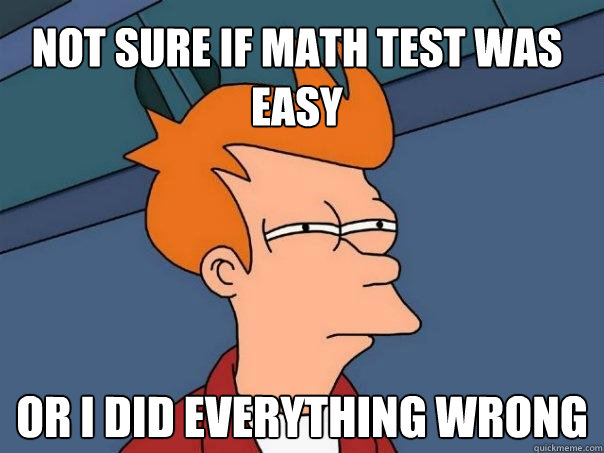
I was surfing the web and stumbled across this! This is a meme of Futurama’s Fry. Sometimes I feel just like this after a test. Hopefully, this won’t be the case anymore! I’ve been studying like there’s no tomorrow!

Philosophizing with numbers and functions

We’re currently learning about limits in class. A good amount of the functions we look at are conteuous everywhere. They go on forever. I was thinking about that today, how equations can seem to go on forever through time but we can’t. Not people, the earth, moon, or sun. We all die eventually. The world will stop turning after a fashion because the core will lose the heat it has. It will take a long time but it will happen. When the earth stops turning, there will only be very select places that will be viable to life. At least to like bigger than archea bacteria and other single celled organisms. The sun will eventually implode creating a black hole. Eventually, this cycle should repeat with a new universe once everything slowly comes back together. But this is only the conclusion that can be drawn from Stephen Hawking’s view of how the universe came to be.

Anyways, these functions can go on forever which I find strange. We can hardly comprehend what forever is; at least when referring to time. There will never be a graph we can make that’s big enough to encompass the entire y=x function because it goes until infinity. It would be much more probable if the y=x function fluctuated as everything else does. However, equations were not made to mimic nature. They were meant as a way to answer a problem. I wonder if there’s an easier way to express certain equations like maybe the guy who originally came up with parabola’s and all that could have found a less time consuming way. Also, why should numbers act a certain way and why can they only react in one way?

Here I go philosophizing again. I swear, I should have been a philosophy major!! ^^”

Fibonacci Spiral

File:Fibonacci Spiral Real1.jpg

Above is an example of the Fibonacci spiral which is also used to represent the golden mean. This uses  \pi in order to create the sequence. The golden ratio is used in a number of structures, such as the Parthenon, and can also be found in many places in nature. The \pi ratio is found in the body proportions of insects, animals, frogs, and plants. The fact that this ratio appears all throughout nature is surprising. Also, I wonder what brought animals, etc. to evolve in such a way as to mimic this pattern? Perhaps it is something even housed in DNA from the very beginning. Or maybe the pattern is only there because most need to have a reason for things being the way that they are and patterns are the first step in doing so. I’m not saying that we could never discover all the mysteries in the world. There must be a logical reason for everything. But perhaps, we only see what’s favorable to us at the moment. Anyways, I’ll stop with the philosophizing, etc. now. I’m sure it’s horribly boring for some.  ^ ^”


I found out about this pattern awhile ago and thought that it would be fun to share. I found it fascinating that this pattern shows up everywhere of it’s own accord. Especially in nature because nature seems so random and unpredictable. I want to try and connect as much as we are learning with the rest of the world because truthfully, in order to understand something, I have to see how it works. With math this is often a problem for me because we deal with numbers that can’t really be comprehended some of the time. Or the way in which numbers work together can be quite tricky.

There’s quite a lot of information about the spiral so I won’t go into detail here. However, there are a couple of good video’s on it that I will post a link to at the end of the post. One of them is more spiritually inclined, but it does have more information on how the spiral is made.

We’ve been learning about continuous and non-continuous functions in class. The concept so far is pretty easy to grasp. I think this is because I can see it on a graph or imagine the graphed function in my mind. We are looking both at the function being continuous in general and also whether it is continuous at a certain point on in the equation. What I wonder most is how they make the functions that can break off at certain points and then continue on as though it never happened. I assume the equation would have to be complex. I also wonder if people are thinking the same thing I am! xD

Spirit Science

Fibonacci Spiral

Note: I do not own any of these pictures. They are public domain. Here are the links to them in order shown:

Pic 1, Pic 2, Pic 3


In the beginning…

So here it is. My first ever post! I don’t know quite how all of this is going to work out, but I must keep going!

Now onward to math land, where numbers and  5^2‘s roam free, where math is not only found in textbooks, but everywhere!! Actually, math is everywhere and in everything. I’m sure the equations and long algorithms are too complicated for the human mind to really grasp, but they’re there. The numbers are either too small or too big. Those with certain types of autism have no problems with equations and numbers like these.

We are using a type of program called latec (spelt latex) which enables me to type \frac{3}{4}  or \sqrt{556}  instead of 3/4 and square root of (566) or something like that. So now the equations can actually look like equations instead of a big jumbled mess! you can see how greatly spaced out everything is because of it, but that’s okay, at least you can read the equations and math symbols.

In any case, I felt like showing how I worked out a problem and possibly giving a link to a related math resource.

x^2-64  Here we need to factor so I found out what numbers would multiply to -64 and add to 0 because there is no middle factor. Since the only numbers that could add to zero would be 8 and -8, I put them into the factored out equation. Thus getting the answer: (x+8)(x-8)

Here’s a link to a very good math source which goes up to advanced algebra and helped me a lot!

Design a site like this with WordPress.com
Get started